Big Walk
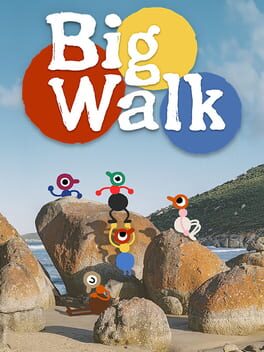
I didn’t really “get” the whole friend-slop genre till this past week. My friend group had a fun enough time with the first act of Peak, but bounced off the difficulty spike in the second act pretty hard. Big Walk is something categorically different, though. A review I read described it as “cooperative Myst”, and that does capture the mechanics, but maybe misses the essence of the game.
Where Peak was very “video-gamey” (health and stamina bars, inventory management, consumable items, etc), Big Walk relies almost entirely on diegetic elements. There are no health bars, no death (apart from the charming network disconnection affordance). No inventory, and when you do find a backpack out in the world, it holds only a single item, and you need a friend to load/unload that item for you. Voice communication is limited to a very short distance around you, so you spend much of the game relying on arm gestures - in service of which, fully half the buttons on your controller are dedicated to moving your character’s arms. You are not required to bring much video game knowledge into the game, every spawn places you directly into a similarly-diegetic and cooperative tutorial.
That all sounds vaguely confusing, but in practice it harmonises beautifully with the hand-designed puzzles that fill the island. They escalate gently in difficulty and gradually train your group to work together. Many puzzles restrict voice communication, forcing you to rely on gestures. One blindfolds a player instead, forcing you to guide them by voice through an obstacle course. Another, which my group named the “therapy room”, locks your team in a small room with a couch for 5 whole minutes, with nothing to do but sit and talk (this was our favourite puzzle room).
I don’t think I’ve had this much fun hanging out with friends in cyberspace in years. Although some of the puzzles can be frustrating, it’s never frustration at your fellow players. By the time we reached the endgame - a gauntlet of puzzles where the player avatars are stripped of identifying characteristics, and voice communication is disabled entirely - and even though our group entered with only pre-arranged signals for yes/no, we found that we had become adept at non-verbal communication, and could both identify specific people by their character’s body movements, and collaborate to construct puzzle solutions solely through the limited palette of gestures.
With communications restored one final time, we waved goodbye to one another, and stepped one-by-one into the light. I felt a distinct sense of shared accomplishment, and of kinship with my fellow players. But no real desire to revisit the game - I think, like so many great experiences, this is something you can only really appreciate the once.